

The Bible has 10 commandments. When people say "12," they almost always mean those 10 plus the 2 greatest commandments Jesus named.
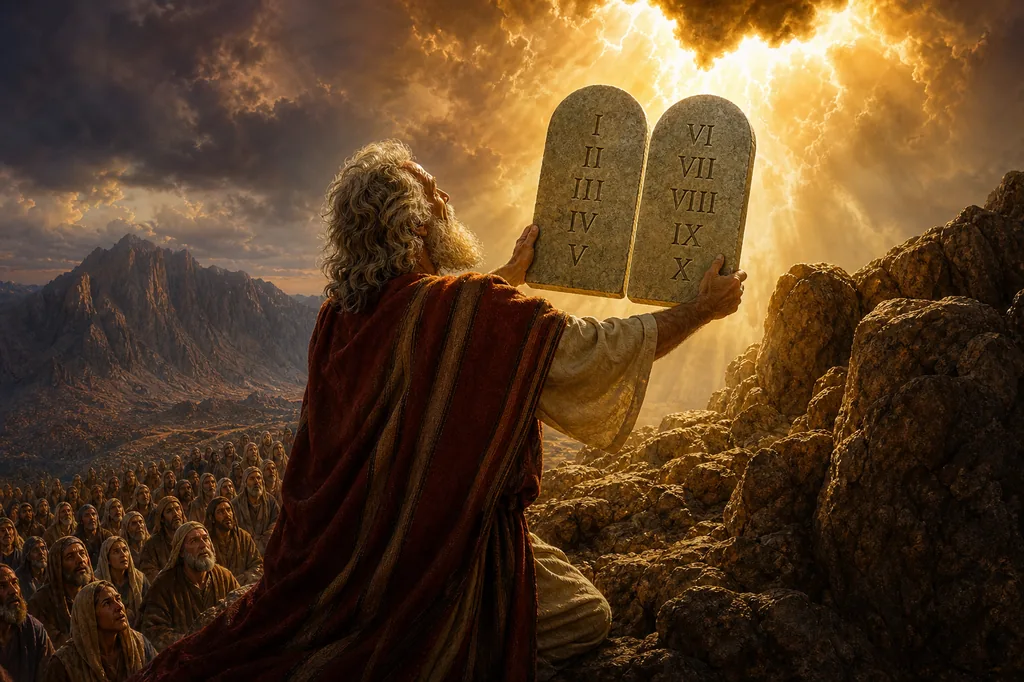
God gave them to Moses on Mount Sinai. They appear in Exodus 20:1-17 and again in Deuteronomy 5:6-21. Jesus named the 2 greatest commandments in Mark 12:30-31: love God with all your heart, and love your neighbor as yourself. There is no separate biblical list of twelve.
The list follows in the order most English Bibles use, with each verse and a one-line meaning.
On this page
| # | Catholic and Lutheran | Protestant and Jewish |
|---|---|---|
| 1 | No other gods (combined with no images) | No other gods |
| 2 | Do not take the Lord's name in vain | No carved images |
| 3 | Keep the Sabbath holy | Do not take the Lord's name in vain |
| 4 | Honor your father and mother | Keep the Sabbath holy |
| 5 | Do not murder | Honor your father and mother |
| 6 | Do not commit adultery | Do not murder |
| 7 | Do not steal | Do not commit adultery |
| 8 | Do not bear false witness | Do not steal |
| 9 | Do not covet your neighbor's wife | Do not bear false witness |
| 10 | Do not covet your neighbor's goods | Do not covet |
Catholic and Lutheran tradition combines "no other gods" and "no carved images" into a single first commandment, then splits "do not covet" into two. Protestant and Jewish tradition keeps them as two distinct first commands and treats coveting as one. The substance is the same in both.
The 10 Commandments
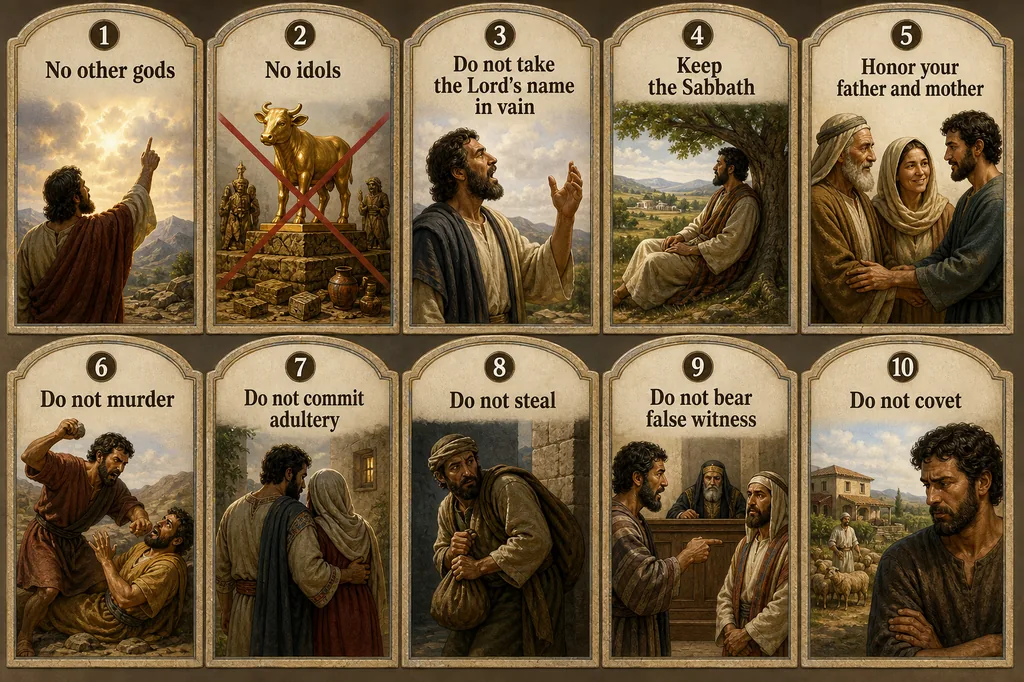
1. You shall have no other gods before me. (Exodus 20:3) - Worship the one true God and no other.
2. You shall not make for yourself a carved image. (Exodus 20:4-6) - Do not make or worship idols. Anything you put before God can become an idol: money, status, comfort, a relationship.
3. You shall not take the name of the Lord your God in vain. (Exodus 20:7) - Treat God's name with reverence. This includes using "God" or "Jesus" as a curse word, but also claiming the name of Christ without living like it.
4. Remember the Sabbath day, to keep it holy. (Exodus 20:8-11) - Set aside one day in seven for rest and worship. Most Christians observe this on Sunday in remembrance of the resurrection.
5. Honor your father and your mother. (Exodus 20:12) - Show respect, care, and obedience to your parents. This is the first commandment with a promise attached: "that your days may be long in the land."
6. You shall not murder. (Exodus 20:13) - Do not take innocent human life. Jesus extended this in Matthew 5:21-22 to include anger and contempt toward another person.
7. You shall not commit adultery. (Exodus 20:14) - Be faithful to your spouse. Jesus extended this in Matthew 5:27-28 to include lustful intent.
8. You shall not steal. (Exodus 20:15) - Do not take what does not belong to you: possessions, time, credit, ideas.
9. You shall not bear false witness against your neighbor. (Exodus 20:16) - Do not lie about others. This includes gossip, slander, and false accusation.
10. You shall not covet your neighbor's house... or anything that is your neighbor's. (Exodus 20:17) - Do not crave what belongs to someone else. Covetousness is the heart-level sin that drives many of the others.
The first four commandments are about your relationship with God. The last six are about your relationships with other people. The same structure shows up later in Jesus' two greatest commandments: love God, love your neighbor.
The 2 commandments Jesus added
When asked which commandment was most important, Jesus answered with two:
"You shall love the Lord your God with all your heart and with all your soul and with all your mind. This is the great and first commandment. And a second is like it: You shall love your neighbor as yourself. On these two commandments depend all the Law and the Prophets." - Matthew 22:37-40 (ESV)
These were not new commandments. Jesus was quoting Deuteronomy 6:5 ("love the Lord your God") and Leviticus 19:18 ("love your neighbor as yourself") and naming them as the two on which everything else in the Bible's moral teaching rests.
When modern writers refer to "the 12 commandments of God," this is almost always what they mean: Moses' 10 plus Jesus' 2.
What about the 12 commandments in the Bible?
The phrase "12 commandments in the Bible" comes up in a few different contexts:
- The 10 of Moses + the 2 of Jesus - by far the most common.
- Counting Exodus 20 verses differently - a small number of writers have counted the prologue ("I am the Lord your God") as a separate command, but the Bible itself calls them "the ten words" in Exodus 34:28 and Deuteronomy 4:13.
- Off-topic listicles - "12 commandments of leadership," "12 commandments for seniors," and similar are rhetorical and have nothing to do with scripture.
The biblical count is, and has always been, ten.
How Catholics and Protestants number the commandments
The same ten commandments are numbered differently across Christian traditions. The commands themselves are identical; only the grouping changes.
Catholic and Lutheran tradition combines "no other gods" and "no carved images" into a single first commandment, then splits "do not covet" into two. Protestant and Jewish tradition (which the Reformers followed) keeps them as two distinct first commands and treats coveting as one. Both readings can be defended from the Hebrew text. The substance is the same.
Are the Ten Commandments still binding for Christians?
The short answer: the moral substance of nine of the ten is accepted in nearly every Christian tradition. The Sabbath is the one where traditions disagree.
- Catholic and Eastern Orthodox - all ten are binding. Sunday worship is treated as the Christian fulfillment of the Sabbath.
- Most Reformed and Presbyterian - all ten remain morally binding, with the day shifted to Sunday.
- Lutheran, Anglican, and most evangelical traditions - the nine moral commandments remain in force; the Sabbath is fulfilled in Christ, with Sunday worship as the practical pattern.
What all traditions agree on: the commandments against murder, adultery, theft, false witness, dishonoring parents, and coveting are restated throughout the New Testament (Matthew 19:18-19, Romans 13:8-10) and apply to Christians today.
For an example of how these standards extend to a modern habit not directly named in scripture, see is vaping a sin?
Where the Ten Commandments are in the Bible
The full text is given twice:
- Exodus 20:1-17 - the original giving at Mount Sinai.
- Deuteronomy 5:6-21 - Moses repeats them to the next generation forty years later, before they enter the Promised Land.
The two passages are nearly identical. The one notable difference is in commandment 4: in Exodus the Sabbath is grounded in creation ("for in six days the Lord made heaven and earth"), and in Deuteronomy it is grounded in the exodus from Egypt ("you shall remember that you were a slave in the land of Egypt").
The commandments are quoted and applied throughout the rest of the Bible, most directly in Matthew 19:17-19, Romans 13:8-10, and James 2:8-11.
Frequently asked questions
What are the 12 commandments in the Bible?
The Bible has 10 commandments (Exodus 20:1-17). The phrase "12 commandments" usually means those 10 plus the 2 greatest commandments Jesus named in Mark 12:30-31: love God with all your heart, and love your neighbor as yourself.
What did Jesus add to the 10 Commandments?
Jesus did not add new commandments. When asked which was the greatest, he named two existing Old Testament commands (Deuteronomy 6:5, love God; Leviticus 19:18, love your neighbor) and said all the Law and the Prophets depend on them (Matthew 22:40). In John 13:34 he does give a new command: "love one another as I have loved you."
What are the 12 commandments in order?
If you list them as 10 + 2: no other gods, no idols, do not take God's name in vain, keep the Sabbath, honor your parents, do not murder, do not commit adultery, do not steal, do not bear false witness, do not covet, love the Lord your God with all your heart, and love your neighbor as yourself.
Are the Ten Commandments in the New Testament?
In pieces. Jesus quotes commandments 6 through 9 in Matthew 19:18-19 and Mark 10:19. Paul summarizes the second-table commandments in Romans 13:8-10. James 2:8-11 references commandments 6 and 7. The full ten are not re-listed together anywhere in the New Testament.
Are the Ten Commandments different in the Catholic Bible?
The text is identical. The numbering differs. Catholics combine "no other gods" with "no images" and split "do not covet" into two. Same ten commands, different count.
What is the greatest commandment?
Jesus answered this directly when asked: "You shall love the Lord your God with all your heart and with all your soul and with all your mind" (Matthew 22:37). He named the second greatest as "love your neighbor as yourself" (Matthew 22:39).