

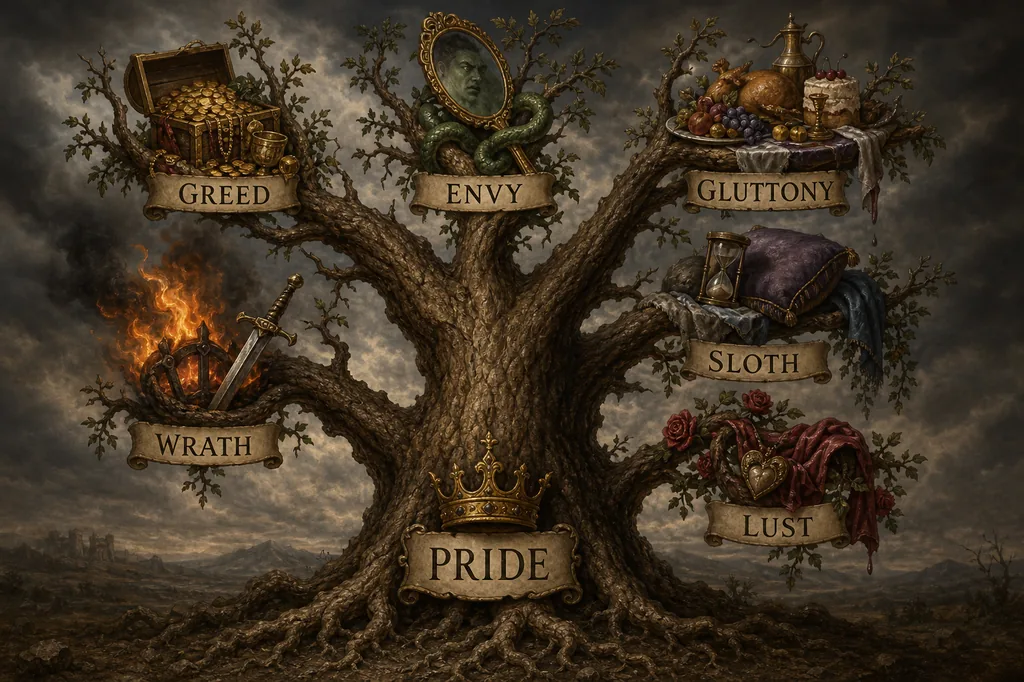
Seven sins, one list, one pope who did the editing. Pride, greed, lust, envy, gluttony, wrath, and sloth are called "deadly" not because they outrank other sins, but because every other sin tends to grow out of them. Kill the root and the branches starve.
Pope Gregory the Great fixed the seven around 590 AD, trimming an older list of eight from the desert fathers. The phrase "ten deadly sins" is almost always a modern misunderstanding: usually the anime, occasionally the IRS, never the Church.
On this page
| Sin | Latin | Greek (Evagrius) | Opposing virtue | Biblical anchor |
|---|---|---|---|---|
| Pride | superbia | ὑπερηφανία (hyperēphania) | Humility | Proverbs 16:18 |
| Greed | avaritia | φιλαργυρία (philargyria) | Charity | 1 Timothy 6:10 |
| Lust | luxuria | πορνεία (porneia) | Chastity | Matthew 5:27-28 |
| Envy | invidia | - (added by Gregory) | Kindness | Galatians 5:21 |
| Gluttony | gula | γαστριμαργία (gastrimargia) | Temperance | Philippians 3:19 |
| Wrath | ira | ὀργή (orgē) | Patience | Galatians 5:20 |
| Sloth | acedia | ἀκηδία (akēdia) | Diligence | Proverbs 6:9-11 |
The Latin terms are the medieval Western consensus following Cassian and Gregory; the Greek terms come from Evagrius Ponticus's original eightfold scheme. Gregory the Great added invidia (envy) to the list.
Origin of the list
The Christian tradition of cataloging a fixed number of capital vices begins with the desert fathers of the 4th century. The earliest extended treatment comes from Evagrius Ponticus (c. 345-399 AD), a Greek-speaking monastic theologian who wrote in his Praktikos of eight logismoi (evil thoughts) that beset the soul: gluttony (γαστριμαργία), fornication (πορνεία), avarice (φιλαργυρία), sadness (λύπη), wrath (ὀργή), acedia (ἀκηδία), vainglory (κενοδοξία), and pride (ὑπερηφανία).
Evagrius's student John Cassian carried the eightfold scheme into Western Christianity. He translated and adapted it in his Institutes and Conferences in the early 5th century, and his Latin renderings - gula, fornicatio, philargyria, tristitia, ira, acedia, cenodoxia, superbia - became the basis for the medieval Latin tradition.
Around 590 AD, Pope Gregory I (Gregory the Great) revised the list in his commentary on Job, the Moralia in Job. He merged Cassian's tristitia and acedia into one vice, merged cenodoxia and superbia into pride, and added envy (invidia). The resulting seven - pride, envy, wrath, sloth, avarice, gluttony, and lust - has been the standard in Western Christianity ever since.
Thomas Aquinas (c. 1225-1274) defended Gregory's list in the Summa Theologica. He preferred the term capital sins (peccata capitalia) because the seven are the "head" or font from which other sins follow. Augustine had argued in City of God that pride is "the beginning of all sin"; Aquinas adopted the position and treated pride as the root of the other six.
Lust (luxuria)
Lust is disordered desire, usually sexual, though tradition also applies the term to desire for money, power, or status. Henry Edward Manning, the 19th-century Catholic Archbishop of Westminster, wrote that lust makes a person "a slave of the devil." Aquinas treated lust as the mildest of the capital sins, since it is the abuse of a faculty humans share with animals and sins of the flesh are less grievous than sins of the spirit.
Paul lists sexual immorality among the "works of the flesh" in Galatians 5:19. In Matthew 5:27-28 Jesus teaches that lustful intent already constitutes adultery of the heart.
Gluttony (gula)
Gluttony is the overconsumption of food and drink. The Latin gluttire means "to gulp down." In Summa Theologica II-II, q. 148, Aquinas distinguished five forms - praepropere (too soon), laute (too expensively), nimis (too much), ardenter (too eagerly), and studiose (too daintily) - and argued that fixating on meals or fussing over delicacies counts as gluttony, not just plain overeating.
Proverbs 23:20-21 warns against gluttons and drunkards; Philippians 3:19 describes those whose "god is their belly."
Greed (avaritia)
Greed, or avarice, is the disordered desire for wealth or possessions. Gregory the Great defined it broadly as "treachery, fraud, deceit, perjury, restlessness, violence and hardnesses of heart against compassion." Aquinas held that greed, like pride, can be a gateway to further evil. Manning wrote that avarice "plunges a man deep into the mire of this world, so that he makes it to be his god."
1 Timothy 6:10 calls the love of money "a root of all kinds of evils." Colossians 3:5 treats greed as idolatry. See also 1 Corinthians 6:10.
Sloth (acedia)
In its original sense sloth was not laziness but acedia - a state of spiritual indifference, sometimes called "the noonday demon" by the desert fathers, that left monastics unable to feel either joy or sorrow about their relationship with God. Aquinas defined sloth in the Summa as "sorrow about spiritual good."
In modern usage the term has broadened to include habitual idleness and the refusal to act on duty. Proverbs 6:9-11 portrays the sluggard; James 4:17 reads, "whoever knows the right thing to do and fails to do it, for him it is sin."
Wrath (ira)
Wrath is disordered anger - anger held onto, or turned into cruelty. The Christian tradition does not treat all anger as sin; Ephesians 4:26 reads, "Be angry and do not sin." The sin is what anger becomes when retained. Aquinas distinguished righteous anger (a response to genuine injustice) from sinful wrath (anger disproportionate to its cause or directed at unjust ends).
Paul lists "fits of anger" among the works of the flesh in Galatians 5:20. See also James 1:19-20.
Envy (invidia)
Envy is sorrow at another's good. Where greed wants what one does not have, envy resents another for having it. Augustine treated envy as the sin most opposed to charity, since love rejoices in the good of others and envy refuses to. The biblical archetype is Cain, whose envy of Abel led to the first murder (Genesis 4).
Envy appears in Paul's vice list at Romans 1:29 and again in Galatians 5:21. Proverbs 14:30: "a tranquil heart gives life to the flesh, but envy makes the bones rot."
Pride (superbia)
Pride is the disordered love of self over God and others. Gregory, Aquinas, and Augustine all treat pride as the root of the other six capital sins, on the reasoning that envy, greed, lust, wrath, gluttony, and sloth each presuppose an inflated sense of self. Augustine wrote in City of God (14.13) that pride is "the beginning of all sin"; Aquinas adopted the position in the Summa.
Proverbs 16:18: "Pride goes before destruction." James 4:6 echoes the same warning. In Mark 7:22 Jesus lists pride among the evils that come from the heart.
Why some lists say 10 deadly sins
There is no traditional Christian list of ten deadly sins. The phrase usually traces back to one of four places.
The most common is the anime Seven Deadly Sins, written by Nakaba Suzuki (manga 2012-2020; Netflix series 2014-2021). It features an antagonist group called The Ten Commandments, distinct from the seven sins themselves. Searches that pair "seven deadly sins" with "10 commandments" usually point to this anime, not to Christian theology.
Some modern Christian writers expand Gregory's seven by adding three failings against the three theological virtues of faith, hope, and love: apostasy (against faith), despair (against hope), and hatred or indifference (against love). These additions are devotional and were never part of the patristic or scholastic lists.
The "IRS 10 deadly sins" is a nickname for the ten categories of misconduct in the Internal Revenue Service Restructuring and Reform Act of 1998 that can result in dismissal of revenue officers. It has nothing to do with Christian theology.
The rest are business listicles in the "10 deadly sins of [topic]" format - leadership, marketing, sales, parenting, and so on. These are rhetorical and have no connection to the Christian tradition.
The seven heavenly virtues
Christian tradition pairs the seven deadly sins with seven virtues that counter them. The pairings, sometimes called the contrary virtues, were developed from Prudentius's Psychomachia (c. 405 AD), an allegorical Latin poem in which the virtues do battle with the vices.
- Pride is opposed by humility.
- Greed is opposed by charity (generosity).
- Lust is opposed by chastity.
- Envy is opposed by kindness (or gratitude).
- Gluttony is opposed by temperance.
- Wrath is opposed by patience.
- Sloth is opposed by diligence.
Together with the three theological virtues (faith, hope, and love) from 1 Corinthians 13:13 and the four cardinal virtues (prudence, justice, fortitude, temperance) inherited from classical philosophy, the seven contrary virtues round out the ethical framework of medieval Latin theology.
Are the seven deadly sins in the Bible?
The phrase "seven deadly sins" does not appear in the Bible, and the specific list of seven is not enumerated together in any single biblical passage. The closest scriptural parallel is Proverbs 6:16-19, which names seven things the Lord hates: haughty eyes, a lying tongue, hands that shed innocent blood, a heart that devises wicked plans, feet that hurry to evil, a false witness, and one who sows discord. The list is structurally similar but differs in content from Gregory's seven.
Each of the seven appears, however, in one or more of the New Testament's vice lists - most notably Galatians 5:19-21 (works of the flesh), Romans 1:29-31, 1 Corinthians 6:9-10, and Mark 7:21-22. For a fuller treatment of these lists see sins in the Bible; for a modern application of these scriptural principles, see is vaping a sin?
Cultural reception
The seven deadly sins have shaped Western art and literature since the medieval period. Dante's Inferno (c. 1320) organizes the lower circles of hell around the seven; the Purgatorio organizes the mountain of purgation around their corresponding cleansings. Geoffrey Chaucer's "The Parson's Tale" in The Canterbury Tales (c. 1390) treats each sin in turn. Hieronymus Bosch's The Seven Deadly Sins and the Four Last Things (c. 1500) is the most widely reproduced visual treatment. In the modern period the sins have framed films like David Fincher's Se7en (1995) and shows like the Fullmetal Alchemist and Seven Deadly Sins anime franchises.
Frequently asked questions
What are the 7 deadly sins in order?
In the order Pope Gregory I set in 590 AD, from least to most grave: lust, gluttony, greed, sloth, wrath, envy, pride.
Are the seven deadly sins in the Bible?
The phrase is not. Each individual sin appears in biblical vice lists (Galatians 5:19-21, Romans 1:29-31, 1 Corinthians 6:9-10, Mark 7:21-22), and Proverbs 6:16-19 names seven things the Lord hates. The count of seven comes from Gregory the Great, not from scripture.
What is the worst of the seven deadly sins?
Pride. Augustine, Gregory the Great, and Thomas Aquinas all treat pride as the root from which the other six follow.
Who created the seven deadly sins?
The list was set by Pope Gregory I (Gregory the Great) around 590 AD, consolidating an earlier list of eight by John Cassian, which itself rested on Evagrius Ponticus.
Is there a list of ten deadly sins?
Not in Christian tradition. The phrase usually refers to the anime Seven Deadly Sins, modern devotional additions of three theological failings (apostasy, despair, hatred), or unrelated business and legal idioms.
What is the difference between the seven deadly sins and the Ten Commandments?
The Ten Commandments (Exodus 20:1-17) are biblical commands given through Moses. The seven deadly sins are a 6th-century theological catalog of capital vices. The Ten Commandments are scripture; the seven deadly sins are tradition.
References
- Evagrius Ponticus, Praktikos §6 (late 4th century). English edition: John Eudes Bamberger, trans., Evagrius Ponticus: The Praktikos and Chapters on Prayer, Cistercian Studies 4 (Spencer, MA: Cistercian Publications, 1972). ↩
- John Cassian, Institutes 5-12 and Conferences 5 (early 5th century). English edition: Boniface Ramsey, trans., John Cassian: The Institutes, Ancient Christian Writers 58 (Mahwah, NJ: Newman Press, 2000). ↩
- Gregory the Great, Moralia in Job 31.45 (c. 590 AD). On the consolidation of Cassian's eight into Gregory's seven, see Carole Straw, Gregory the Great: Perfection in Imperfection (Berkeley: University of California Press, 1988), 36-46. ↩
- Thomas Aquinas, Summa Theologica I-II, q. 84, a. 4 (on the capital sins) and II-II, q. 162, a. 7 (on pride as the principal sin). For Augustine on pride as 'the beginning of all sin,' see City of God 14.13. ↩
- Prudentius, Psychomachia (c. 405 AD). English edition: H. J. Thomson, trans., Prudentius, Loeb Classical Library, vol. 2 (Cambridge, MA: Harvard University Press, 1949). ↩