

The Bible describes patience as staying faithful through a long wait and treating people with love. James pictures a farmer waiting for rain: the crop matters, and it cannot be hurried.
On this page
- 011. James sends impatient people to a farmer
- 022. Patience grows on the Spirit's list of fruit
- 033. Proverbs ranks self-control above conquering a city
- 044. Love gives people time to finish the sentence
- 055. Job's endurance included some hard questions
- 066. 'How long?' belongs in a faithful prayer
- 077. God's patience makes room for a changed life
1. James sends impatient people to a farmer
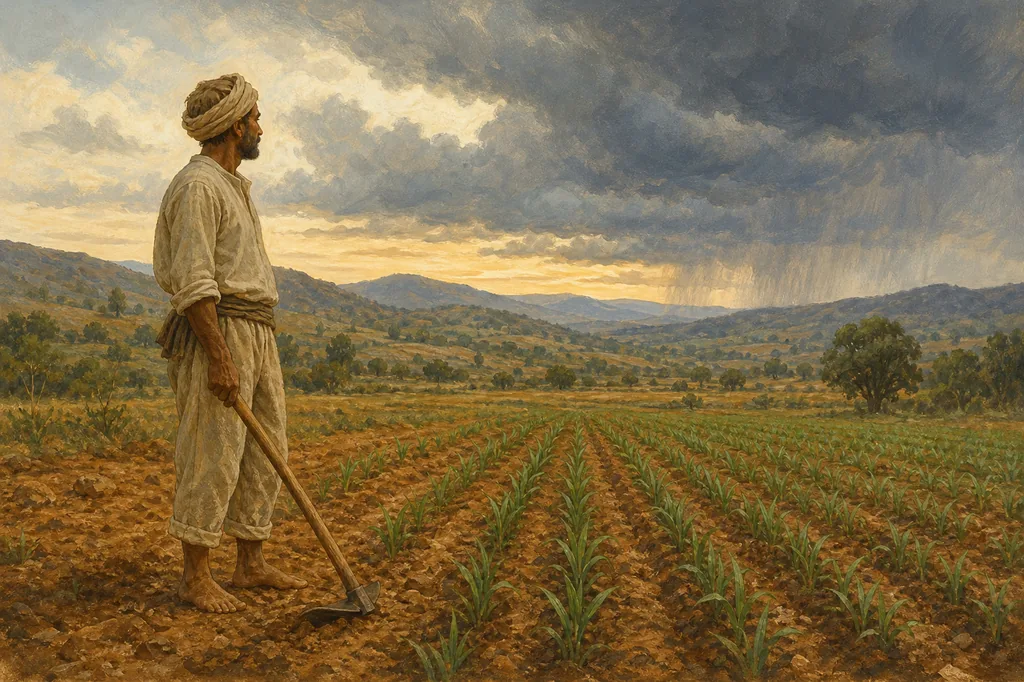
In James 5:7-8, a farmer waits for the land's valuable crop and the seasonal rains. James uses that picture to encourage Christians waiting for the Lord's coming. The harvest has value long before the farmer can carry it home.
Anyone who has planted something knows the temptation to check it constantly. You can prepare the ground and tend the field; you cannot tug a seedling into maturity. Applied to everyday life, that picture gives patience something to do: care for what is yours to tend while allowing time for what you cannot control.
Send the application or have the conversation you have been putting off. A delayed result does not make today's faithful work pointless.
2. Patience grows on the Spirit's list of fruit
Galatians 5:22-23 places patience among the fruit of the Spirit, alongside love, joy, peace, kindness, and self-control. If your Bible says longsuffering, you have found the same item in older English.
That matters when you have decided you are simply 'an impatient person.' Paul describes a quality that can grow as a person walks with the Spirit. Your quickest reaction need not become your permanent character.
Start with one familiar pressure point: the slow reply, the interrupted task, the question you have already answered twice. Ask God for help there, where another person will actually experience the difference.
3. Proverbs ranks self-control above conquering a city
Proverbs 16:32 makes a startling comparison: being slow to anger is better than being mighty, and ruling your spirit is better than taking a city. Winning an argument can look impressive while costing you the very relationship you wanted to protect.
James 1:19-20 brings that strength into conversation: listen readily, take time before speaking, and be slow to anger. You can feel the heat rise and still choose the next sentence.
Christian tradition pairs patience with wrath in the seven deadly sins and their opposing virtues. One place to practice is the unsent message: read it once more before handing your anger a permanent record.
4. Love gives people time to finish the sentence
First Corinthians 13:4 begins its description of love with patience. That brings a familiar wedding reading straight into the ordinary afternoon when someone interrupts you for the third time.
First Thessalonians 5:14 makes this concrete: encourage the fainthearted, help the weak, and be patient with everyone. Different people need different kinds of care. Treating every delay as laziness is an easy way to miss what someone actually needs.
Let a person explain without composing your rebuttal halfway through. Give someone learning a task room to learn it. When frustration makes you want to complain about them to the group, remember how quickly gossip can break trust. Patience often begins with the words you choose in that moment.
5. Job's endurance included some hard questions
James 5:11 points to Job's endurance and to the Lord's compassion. Read Job itself and you meet a man who grieves, protests, and asks searching questions. His endurance was far more anguished than the familiar phrase 'the patience of Job' can suggest.
Romans 5:3-5 describes a movement from suffering to endurance, then character and hope. Paul offers encouragement to people going through trouble; there is no demand here that a hurting person smile through it.
Staying faithful can include asking for help, naming a wrong, or leaving a dangerous situation. Patience does not require offering yourself up for more harm.
6. 'How long?' belongs in a faithful prayer
Psalm 13 opens with repeated questions about how long the distress will last. It ends with trust and a song. The psalm carries both the ache of waiting and the decision to keep turning toward God.
Romans 12:12 puts hope, patience in trouble, and persistent prayer together. Prayer gives you somewhere to bring the waiting instead of letting it fill every conversation with resentment.
You can pray plainly: 'God, I am tired of this wait. Help me act with love today, and show me the next thing I can do.' You do not have to invent a cheerful mood before you begin.
7. God's patience makes room for a changed life
Second Peter 3:9 addresses people questioning the Lord's promised return. The passage explains the delay in terms of God's patience and desire for repentance. What looks like slowness from one angle is an opportunity to turn back from another.
His point gives readers a reason to repent now; it does not put a delivery date on every personal wish. Use the time you have to respond to God and to treat other people with the patience you need yourself.
Choose one small act today: let someone finish speaking, do a necessary task without demanding instant results, or bring an unanswered question into prayer. Those are ordinary places for patience to take root.
Frequently asked questions
What is patience according to the Bible?
Biblical patience includes being slow to anger, bearing with other people in love, and enduring difficulty while trusting God. Galatians 5:22-23 names patience as fruit of the Spirit, and James 5:7-11 illustrates it through a farmer and through faithful endurance.
What is a good Bible verse about patience?
James 5:7-8 is a memorable starting point: it compares patient waiting for the Lord to a farmer waiting for the crop and seasonal rains. For patience with people, read 1 Corinthians 13:4 and 1 Thessalonians 5:14.
Does being patient mean doing nothing?
No. James's farmer waits for the harvest, but farming involves work. Biblical patience can mean continuing to do what is right while accepting that you cannot force the timing of every result. It can include speaking honestly, seeking help, and setting a boundary.
Can I ask God why I have to wait?
Yes. Psalm 13 repeatedly asks how long the distress will last and still ends in trust. Honest questions and persistent prayer can belong together. You do not have to hide your frustration to pray.
How can I become more patient as a Christian?
Ask for the Spirit's help, identify one situation where you tend to rush or snap, and practice a specific response there. James 1:19 offers a useful pattern: listen readily, take time before speaking, and be slow to anger. Return to it when you fall short.