

You are the most excellent of the sons of men. Grace has anointed your lips, therefore God has blessed you forever.
Public domain · Read the whole chapter (KJV)
Psalm 45:2 praises a king on his wedding day: he is striking to look at, gracious in speech, and blessed by God. The poem opens with admiration before turning to his rule.
On this page
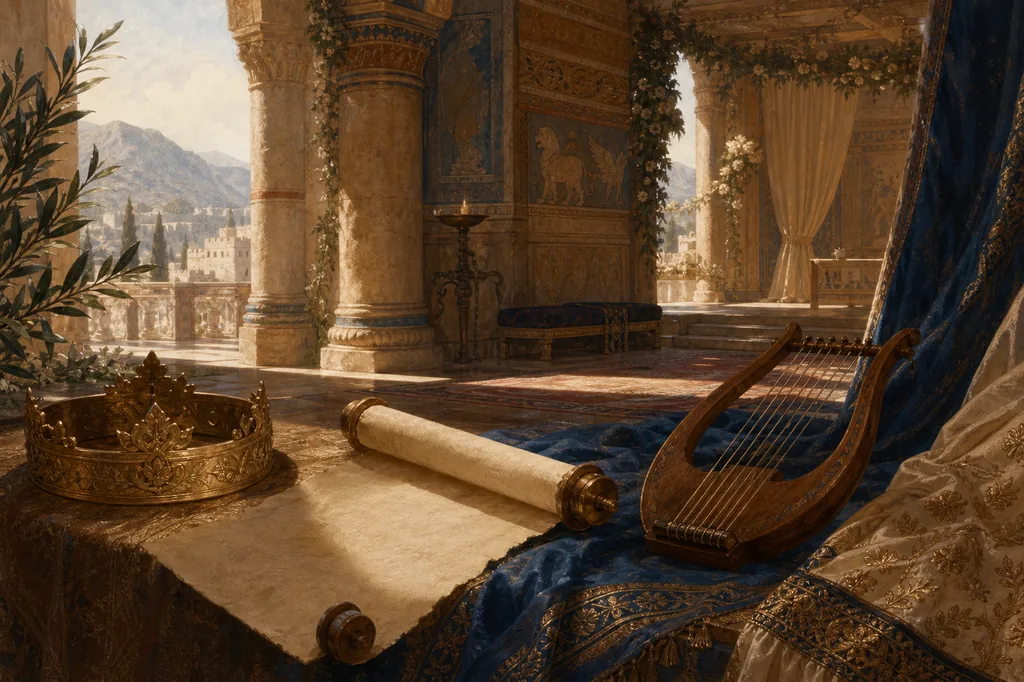
A wedding song addressed to a king
The heading of Psalm 45 identifies it as a wedding song associated with the sons of Korah. In verse 1, a poet announces that he has composed verses for the king. Verse 2 begins his address to that king.
The rest of the scene is lavish: fragrant garments, music, a queen dressed in gold, and a bride entering the palace with her companions. This is praise written for a royal celebration. The poem does not name the king, so identifying him as Solomon or another particular ruler goes beyond what it says.
That setting gives the word 'you' its starting point. The poet is speaking to the royal bridegroom. Reading the verse within the song lets its language of beauty, speech and blessing come into focus.
Why the poet praises his beauty
The opening line places the king above other men in attractiveness. English translations bring this out with words such as handsome, fair or excellent. It is the heightened language of a celebration, much as a wedding speech might describe the bride or groom as incomparable.
The praise soon becomes more demanding. Verse 4 connects the king's majesty with truth, humility and righteousness; verse 7 celebrates his love of righteousness. His appearance draws the poet's attention, but the portrait of a good ruler also includes how he speaks and governs.
Grace on his lips means something about his speech
The image of anointed lips turns the focus from the king's appearance to his words. The United Bible Societies translation commentary explains the expression through eloquent or gracious speech. The praise can suggest words that are well chosen, pleasing and considerate.
Picture a ruler addressing someone who has come to him with a request. His response matters: he can humiliate the person, evade the question, or listen and speak with care. The psalm does not narrate that scene, but it helps us hear why a poet would praise a king's lips alongside his strength.
The verse's image joins beauty with the way someone speaks. A charming appearance and cruel words would pull that portrait apart.
The blessing reaches beyond the wedding day
The final line announces God's enduring blessing on the king. The celebration looks beyond a single day's splendor: later verses speak about his throne, his descendants and the remembrance of his name.
Within the poem, beauty and gracious speech belong to this portrait of a favored king. The line is not a formula in which good looks earn God's approval. It praises the king's gifts while placing his future under God's blessing.
How Hebrews connects Psalm 45 with Jesus
Hebrews 1:8-9 quotes Psalm 45:6-7 and applies those words about an enduring throne and righteous rule to the Son. That explicit connection is a central reason Christians read the royal wedding song in relation to Jesus.
Hebrews quotes the throne-and-righteousness lines, rather than verse 2 itself. We can follow that connection without losing the wedding scene in which the poem begins: a song addressed to a king becomes part of the New Testament's account of Christ's kingship.
The gracious-speech theme also has a natural Christian resonance. In Luke 4:22, people respond with wonder to Jesus' gracious words. The connection invites attention to what he says and does, rather than speculation about his physical appearance.
Notice what your words leave behind
The line about gracious lips offers a concrete question to carry into a conversation: what will my words do to the person hearing them? A correction can be clear without being contemptuous. A compliment can name something true instead of flattering. An apology can acknowledge harm without adding an excuse.
For example, 'You never listen' closes a conversation quickly. 'I felt dismissed when I was interrupted; can I finish what I was trying to say?' gives the other person something specific to respond to. Gracious speech can still be honest about conflict.
Read the whole psalm, then choose one conversation in which to practice that kind of care. Small acts like this belong to putting faith into practice. If you are reading the passage for a wedding, its royal celebration can also open a conversation about the faithfulness and care a marriage asks of both people.
Frequently asked questions
What does Psalm 45:2 mean in simple terms?
A poet praises a king's beauty, gracious speech and lasting blessing from God. The verse belongs to a royal wedding song, and the following lines connect the king's majesty with righteous rule.
Is Psalm 45:2 about Jesus?
The poem addresses a king at a royal wedding. Christians also read it in relation to Jesus because Hebrews 1:8-9 applies Psalm 45:6-7 to the Son. Hebrews makes that connection through the king's throne and righteousness, without directly quoting verse 2.
Can I send Psalm 45:2 to my boyfriend or use it at a wedding?
Its setting makes it a natural verse to consider for a wedding or an affectionate message. Share it as poetry of admiration, remembering that its original addressee is a king. It is not a prediction about the future of a particular relationship.
Why do translations use handsome, fair or excellent?
These choices express the opening line's praise of the king. In this setting, older English fair refers to beauty. Reading the following lines about speech and righteous rule helps show the larger portrait the poet is creating.