

Start with one short scene in a Gospel, notice what happens, and answer what you read. Mark 2:1-12 is a good first session: a crowded house, a torn roof, and a question about Jesus.
On this page
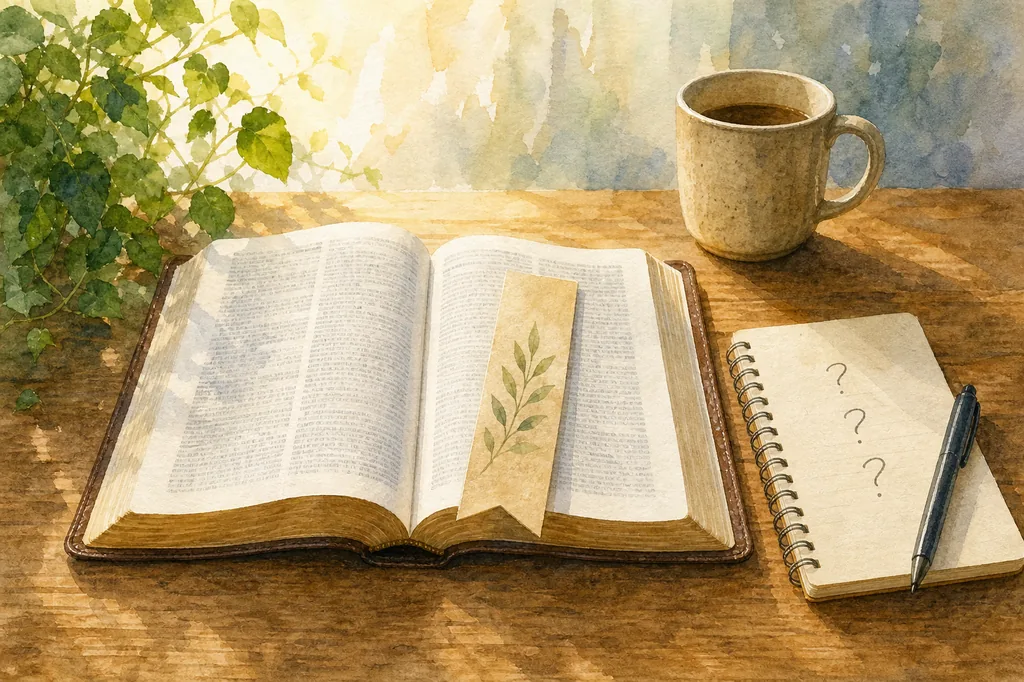
Try your first reading in Mark 2
Open to Mark 2:1-12. In a printed Bible, find the book name, then chapter 2 and verses 1 through 12. In an app, search for the reference. Read the whole scene once without stopping to solve every question.
Four friends carry a paralyzed man to Jesus, but the doorway is blocked. They open the roof and lower him into the room. Jesus first tells the man that his sins are forgiven. When teachers object that only God can forgive sins, Jesus tells the man to stand, take his mat, and go home. He does.
Now read it again with three questions: What happens? What does this show me about Jesus? What response does it invite from me? Keep the answers close to the scene. You might notice the friends' determined care, Jesus' authority to forgive, and the shocked crowd. Your response might be a prayer for help, a question you want to investigate, or a person you can carry toward help in a practical way.
That is a complete reading session. You observed the passage before extracting a slogan from it, and you gave it room to challenge you. Tomorrow, continue with Mark 2:13-17.
Choose a translation you can understand aloud
The Bible was written mainly in Hebrew, Aramaic, and Greek, so an English Bible is a translation. Some translations preserve more of the source wording and sentence structure; others prioritize natural contemporary English. Both approaches involve careful choices. If the library itself feels unfamiliar, this guide explains how the Bible's books are organized.
For a first read, try a clear modern translation such as the New Living Translation, New International Version, Christian Standard Bible, or New Revised Standard Version Updated Edition. Read the same paragraph in two versions and choose the one you can follow without constantly untangling the sentences. A church community may also have a customary translation worth using alongside it.
Creed's Bible reader currently uses the King James Version. Its language is beautiful and influential, but words such as thee, thou, and older meanings can slow a beginner down. If a sentence feels opaque, compare it with a modern translation instead of assuming the Bible itself is beyond you.
Follow a route that gives you landmarks
You do not have to begin at Genesis and read straight through. The Bible is a library of narrative, poetry, prophecy, wisdom, Gospels, history, and letters. Starting with Jesus gives a beginner a clear center, while later books fill in the story around him.
Begin with Mark for a fast-moving account of Jesus' actions, or John for longer conversations about who Jesus is. Then read Acts to follow the first Christian communities. Move to Genesis and Exodus for creation, the patriarchs, liberation from Egypt, and Israel's covenant story. Add Psalms for prayer and Philippians or James for short New Testament letters. After those landmarks, return to a whole Testament or use a full-Bible plan.
- Mark: meet Jesus through short, vivid scenes.
- John: hear Jesus' signs and extended conversations.
- Acts: see the message move from Jerusalem outward.
- Genesis and Exodus: learn the beginnings of the story and Israel's rescue.
- Psalms, Philippians, and James: read prayer, encouragement, and practical teaching.
This order is a doorway, not a rule. If your church, class, or family is reading another book, join them. A passage becomes easier to understand when you can discuss it with people who are reading it too.
Read the paragraph before you claim the verse
Chapter and verse numbers help you find a line, but the biblical writers did not compose isolated numbered sayings. Read the paragraph around a verse. Ask who is speaking, who is listening, what problem is unfolding, and what changes by the end.
Then notice the kind of writing. A proverb gives compact wisdom, not a guarantee that erases every exception. A psalm may use metaphor and emotional language. A letter answers the needs of a particular community. A Gospel tells a connected story in which earlier scenes prepare for later ones.
In Mark 2, 'Arise, and take up thy bed' is not a generic command to become productive. It is Jesus' public response to a dispute about his authority, followed by a paralyzed man doing what the room thought impossible. The scene supplies the meaning that a clipped sentence would lose.
Mark the confusing part and keep the book open
When you reach a difficult line, write down the question. Read the paragraphs before and after it, check another translation, and look at the book introduction in a study Bible. A trustworthy introduction can tell you the likely audience, historical setting, and shape of the book without replacing the text itself.
Bring the question to a pastor, priest, teacher, or mature Christian who will examine the passage with you. For a disputed interpretation, listen for the evidence each view uses. Good help should send you back to the text with sharper questions, not ask you to surrender your judgment to a confident personality.
Some questions take time. Keep reading the book while the question remains in your notebook. Later chapters often supply a theme, contrast, or explanation that one paragraph cannot provide alone.
Make tomorrow's reading small enough to begin
Choose a repeatable cue: after breakfast, on the train, or before you plug in your phone at night. Read one scene or paragraph. Five attentive minutes are more useful than a heroic plan you avoid opening.
Keep a bookmark or note with three prompts: What happened? What did I learn about God and people? What question or response will I carry with me? End with a short prayer, even if it is simply, 'God, help me understand and live what is true.' If prayer feels unfamiliar too, begin with this simple pattern from Jesus' teaching.
If you miss a day, continue from the bookmark and start your streak again. You do not owe a reading plan a backlog. Let the streak help you return to Scripture regularly. As reading becomes familiar, lengthen the session or add a plan that takes you through whole books. Then let what you read reach ordinary decisions; this guide shows how to put a passage into practice.
Frequently asked questions
Where should a beginner start reading the Bible?
Start with Mark or John. Mark moves quickly through Jesus' actions; John spends more time on his identity and teaching. Read one complete scene at a time, then continue through the book instead of jumping randomly between verses.
Do I have to start with Genesis?
No. Genesis is essential, but the Bible is a library rather than one modern novel. A beginner can start with a Gospel, continue into Acts, and then read Genesis and Exodus with Jesus and the early church already in view.
How much of the Bible should I read each day?
Read an amount you can understand and return to. One scene or paragraph may be enough for a first session. Finish whole books over time, but do not rush past the people, argument, or images simply to complete a daily count.
What should I do when the Bible does not make sense?
Read the surrounding passage, compare a clear translation, check the book's setting, and write down the exact question. Ask a trustworthy Christian to examine it with you. Keep reading, because the rest of the book may clarify what one paragraph leaves open.