
The Protestant Bible has 66 books: 39 in the Old Testament and 27 in the New. The Catholic Bible has 73, the Eastern Orthodox Bible has 76 to 78, and the Ethiopian Orthodox Tewahedo Bible has 81. The differences come from which Old Testament writings each tradition recognizes as canon.
That answer is enough for most people. The rest of this page explains where each count comes from and why the traditions disagree.
On this page
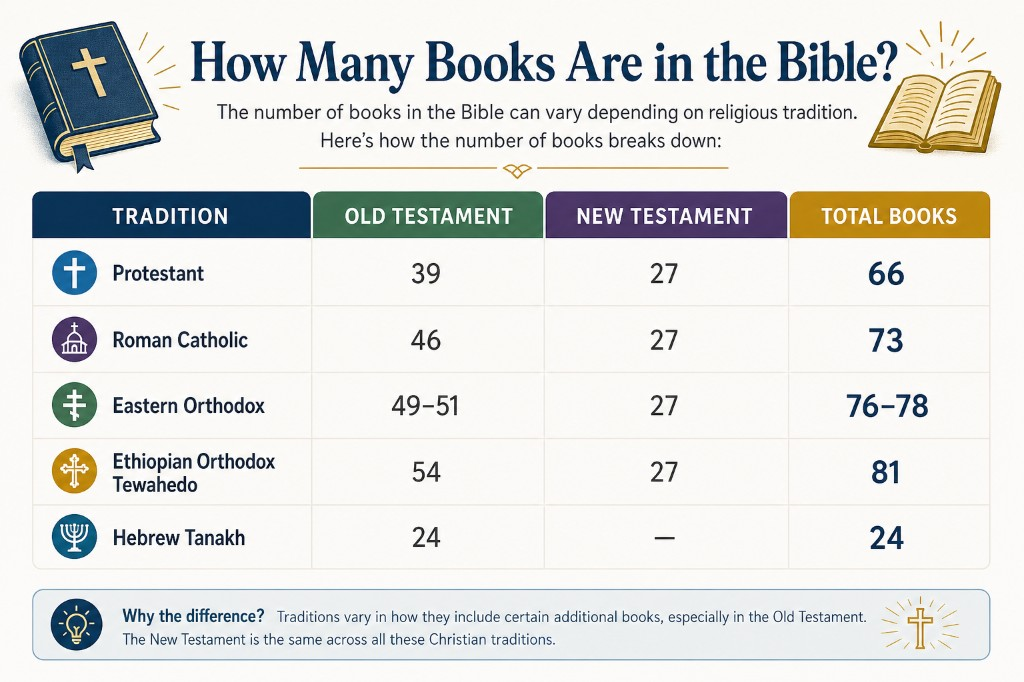
| Tradition | Old Testament | New Testament | Total | Notes |
|---|---|---|---|---|
| Protestant | 39 | 27 | 66 | Excludes the Deuterocanon |
| Roman Catholic | 46 | 27 | 73 | Adds 7 Deuterocanonical books |
| Eastern Orthodox | 49–51 | 27 | 76–78 | Adds 1 Esdras, 3 Maccabees, Prayer of Manasseh, Psalm 151 |
| Ethiopian Orthodox Tewahedo | 54 | 27 | 81 | Broadest canon; includes 1 Enoch, Jubilees, Meqabyan I–III |
| Hebrew Tanakh (Jewish) | 24 | — | 24 | Same content as Protestant OT, grouped differently |
Numbers reflect each tradition's official canon. The Hebrew Tanakh contains the same writings as the Protestant Old Testament but counts them as 24 books rather than 39 because several books (Samuel, Kings, Chronicles, and the twelve Minor Prophets) are grouped together.
How many books are in the Old Testament?
The Protestant Old Testament has 39 books, beginning with Genesis and ending with Malachi. These are the same writings Jewish tradition recognizes as the Tanakh, though Jewish counting combines several of them into 24.
The Old Testament is conventionally grouped into five sections:
- The Law (Torah) — 5 books: Genesis, Exodus, Leviticus, Numbers, Deuteronomy
- Historical books — 12 books: Joshua through Esther
- Wisdom and Poetry — 5 books: Job, Psalms, Proverbs, Ecclesiastes, Song of Solomon
- Major Prophets — 5 books: Isaiah, Jeremiah, Lamentations, Ezekiel, Daniel
- Minor Prophets — 12 books: Hosea through Malachi
How many books are in the New Testament?
All Christian traditions (Protestant, Catholic, Eastern Orthodox, Oriental Orthodox, and Ethiopian) agree on the same 27 books of the New Testament. The canon was settled by the late 4th century, when councils at Hippo (393) and Carthage (397) listed the same 27 books still used today.1
The 27 books are typically grouped as:
- The Gospels — Matthew, Mark, Luke, John
- History — Acts of the Apostles
- Pauline epistles — Romans through Philemon (13 letters)
- General epistles — Hebrews, James, 1–2 Peter, 1–3 John, Jude
- Apocalyptic — Revelation
How many books are in the Catholic Bible?
The Catholic Bible has 73 books: 46 in the Old Testament and 27 in the New. The 7 additional Old Testament books, called the Deuterocanon, are Tobit, Judith, 1 Maccabees, 2 Maccabees, Wisdom (of Solomon), Sirach (Ecclesiasticus), and Baruch. Catholic editions also include longer Greek versions of Esther and Daniel that contain passages absent from Protestant editions.
These books were affirmed as canonical at the Council of Trent in 15462, in response to the Protestant Reformers, who removed them on the grounds that the Hebrew canon did not include them. They had been part of the Septuagint, the Greek Old Testament most often quoted by early Christians, including New Testament authors.3
How many books are in the Orthodox Bible?
Eastern Orthodox Bibles contain 76 to 78 books, depending on the jurisdiction. Greek, Russian, and other Eastern Orthodox churches accept the same 7 Deuterocanonical books Catholics do, plus several additional writings the Orthodox call Anagignoskomena:
- 1 Esdras
- 3 Maccabees
- Psalm 151
- Prayer of Manasseh
Some Slavonic editions also include 2 Esdras (also called 4 Ezra), bringing the count to 78. These books are printed in Orthodox Bibles and read in the liturgy, though they are sometimes treated as a secondary tier of canon below the protocanonical books.
How many books are in the Ethiopian Bible?
The Ethiopian Orthodox Tewahedo Bible is the longest of any Christian canon, with 81 books. In addition to the books in the Catholic and Eastern Orthodox Bibles, the Ethiopian canon includes:
- 1 Enoch — quoted directly in the New Testament book of Jude4
- Jubilees — a retelling of Genesis and Exodus
- Meqabyan I, II, and III — distinct from the Maccabees of other traditions
- A broader collection of historical and devotional writings
The Ethiopian Orthodox Church considers these books fully canonical, on the same level as the rest of Scripture.
How many books are in the King James (KJV) Bible?
The original 1611 King James Bible contained 80 books: 39 Old Testament, 27 New Testament, and 14 Apocryphal books printed between the two testaments.5 By the early 19th century, most Protestant publishers had dropped the Apocrypha, which left the 66-book KJV most readers know today. Some study editions still include the Apocrypha as a separate section.
The same is true for the NIV, ESV, NASB, NLT, CSB, and other modern Protestant translations: 66 books unless an Apocrypha edition is specified.
How many books are in the original Bible?
There was no single "original Bible" with a fixed table of contents. The canon developed over centuries.
- Hebrew Bible — finalized around the 2nd century CE; 24 books6
- Septuagint (Greek Old Testament) — translated 3rd–2nd century BCE; included writings now called Deuterocanonical
- New Testament — 27 books circulated independently; canon settled in the late 4th century at the councils of Hippo (393) and Carthage (397)
- Western canon split — at the Reformation in the 16th century, Protestants adopted the shorter Hebrew Old Testament; Catholics reaffirmed the Deuterocanon at the Council of Trent (1546)
So “how many books were in the original Bible” has no single answer. It depends whether you mean the Hebrew Bible, the Septuagint that early Christians used, or the post-Reformation Protestant canon.
Why do different Bibles have different numbers of books?
Three questions shaped how each tradition built its canon:
- Which Old Testament: Hebrew or Greek? Protestants follow the Hebrew canon. Catholic and Orthodox traditions follow the broader Septuagint, which was the Bible of the early church.
- Which writings did the apostles and early church actually use? Books quoted or referenced by New Testament authors and early Christian writers (like the Apostolic Fathers) carried more weight.
- Which books did regional churches consistently read in worship? Liturgical use over generations was a primary test of canonicity.
The New Testament canon is shared because the same 27 books met all three tests across the early church. The Old Testament differs because each tradition weighted the three tests differently.
The full list of 66 books (Protestant canon)
Old Testament (39): Genesis, Exodus, Leviticus, Numbers, Deuteronomy, Joshua, Judges, Ruth, 1 Samuel, 2 Samuel, 1 Kings, 2 Kings, 1 Chronicles, 2 Chronicles, Ezra, Nehemiah, Esther, Job, Psalms, Proverbs, Ecclesiastes, Song of Solomon, Isaiah, Jeremiah, Lamentations, Ezekiel, Daniel, Hosea, Joel, Amos, Obadiah, Jonah, Micah, Nahum, Habakkuk, Zephaniah, Haggai, Zechariah, Malachi.
New Testament (27): Matthew, Mark, Luke, John, Acts, Romans, 1 Corinthians, 2 Corinthians, Galatians, Ephesians, Philippians, Colossians, 1 Thessalonians, 2 Thessalonians, 1 Timothy, 2 Timothy, Titus, Philemon, Hebrews, James, 1 Peter, 2 Peter, 1 John, 2 John, 3 John, Jude, Revelation.
Frequently asked questions
How many books are in the Bible in total?
That depends on the tradition: 66 in the Protestant Bible, 73 in the Catholic Bible, 76–78 in the Eastern Orthodox Bible, and 81 in the Ethiopian Orthodox Tewahedo Bible.
How many books are in the NIV Bible?
The NIV is a Protestant translation and contains 66 books: 39 Old Testament and 27 New Testament. A handful of editions include the Apocrypha as a separate section.
Why does the Catholic Bible have 7 more books than the Protestant Bible?
Catholic Bibles retain the Deuterocanonical books (Tobit, Judith, 1–2 Maccabees, Wisdom, Sirach, Baruch) from the Greek Septuagint. Protestants follow the shorter Hebrew canon, moved these books to a separate Apocrypha section, and eventually omitted them entirely.
Are the Apocrypha and the Deuterocanon the same thing?
Roughly, yes, though the labels signal different views. "Deuterocanonical" (the Catholic and Orthodox term) means "second canon": canonical, but added later. "Apocrypha" (the Protestant term) means "hidden": included historically but not treated as Scripture.
Did Jesus or the New Testament quote books outside the Protestant canon?
The clearest direct quotation is in Jude 1:14–15, which quotes 1 Enoch. Several other passages in the Gospels and Paul’s letters echo themes from the Deuterocanonical books.
What is the shortest book in the Bible?
3 John, with only 219 words in the original Greek across 14 verses.7
What is the longest book in the Bible?
Psalms, with 150 chapters. By word count, Jeremiah is the longest book.
References
- Bruce M. Metzger, The Canon of the New Testament: Its Origin, Development, and Significance (Oxford: Clarendon Press, 1987), 237–238. See also “Biblical literature: The canon,” Encyclopædia Britannica, britannica.com/topic/biblical-literature/The-canon. ↩
- Council of Trent, Fourth Session, “Decree Concerning the Canonical Scriptures” (April 8, 1546). Translated text via the U.S. Conference of Catholic Bishops, bible.usccb.org. ↩
- Karen H. Jobes and Moisés Silva, Invitation to the Septuagint, 2nd ed. (Grand Rapids: Baker Academic, 2015), 19–22. ↩
- Jude 1:14–15 directly quotes 1 Enoch 1:9. See the HarperCollins Study Bible (NRSV), note on Jude 14, and James H. Charlesworth, ed., The Old Testament Pseudepigrapha, vol. 1 (New York: Doubleday, 1983), 13. ↩
- David Norton, A Textual History of the King James Bible (Cambridge: Cambridge University Press, 2005), 62. The 14 books printed between the testaments in 1611 included 1–2 Esdras, Tobit, Judith, additions to Esther, Wisdom, Sirach, Baruch with the Letter of Jeremiah, additions to Daniel, Prayer of Manasseh, and 1–2 Maccabees. ↩
- Lee Martin McDonald, The Biblical Canon: Its Origin, Transmission, and Authority (Peabody, MA: Hendrickson, 2007), 150–169. The traditional reference to a “Council of Jamnia” finalizing the Hebrew canon is now contested; most scholars place the canon’s effective closure between the 1st and 2nd centuries CE. ↩
- Word counts based on the Nestle-Aland 28th edition Greek New Testament. 3 John is the shortest by Greek word count (219); 2 John (245) is shorter by English verse count in some translations. ↩