
The Book of Revelation has 22 chapters and 404 verses. It is the final book of the New Testament, written by John of Patmos around 95 AD. The book is built in four parts: a prologue, seven letters to seven churches in Asia, a long series of apocalyptic visions, and a short epilogue. The 22-chapter count is the same in every major Christian tradition (Protestant, Catholic, Eastern Orthodox, Ethiopian).
That answer covers most of what people are looking for. The rest of this page is the full chapter map, a short summary of every chapter, what the book is actually about, and who wrote it.
On this page
| Chapter | Section | Title / key event | Verses |
|---|---|---|---|
| 1 | Prologue | John's vision of the risen Christ on Patmos | 20 |
| 2 | Letters | Letters to Ephesus, Smyrna, Pergamum, Thyatira | 29 |
| 3 | Letters | Letters to Sardis, Philadelphia, Laodicea | 22 |
| 4 | Throne | The throne room of heaven | 11 |
| 5 | Throne | The scroll and the Lamb who is worthy to open it | 14 |
| 6 | Seals | The first six seals (four horsemen, martyrs, cosmic earthquake) | 17 |
| 7 | Seals | The 144,000 sealed and the great multitude from every nation | 17 |
| 8 | Trumpets | The seventh seal and the first four trumpets | 13 |
| 9 | Trumpets | The fifth and sixth trumpets (locusts and the 200-million army) | 21 |
| 10 | Trumpets | The mighty angel and the little scroll John is told to eat | 11 |
| 11 | Trumpets | The two witnesses and the seventh trumpet | 19 |
| 12 | Conflict | The woman, the male child, and the dragon | 17 |
| 13 | Conflict | The beast from the sea and the beast from the earth (mark of the beast, 666) | 18 |
| 14 | Conflict | The Lamb on Mount Zion and the harvest of the earth | 20 |
| 15 | Bowls | The seven angels with the seven last plagues | 8 |
| 16 | Bowls | The seven bowls of God’s wrath, ending at Armageddon | 21 |
| 17 | Babylon | The great prostitute and the scarlet beast | 18 |
| 18 | Babylon | The fall of Babylon the Great | 24 |
| 19 | Christ returns | “Hallelujah” in heaven and the rider on the white horse | 21 |
| 20 | Final judgment | The thousand-year reign and the great white throne | 15 |
| 21 | New creation | The new heaven, the new earth, and the new Jerusalem | 27 |
| 22 | Epilogue | The river of life and Christ’s promise: “I am coming soon” | 21 |
All 22 chapters total 404 verses. Counts and chapter divisions are the same in every major Christian tradition (Protestant, Catholic, Eastern Orthodox, Ethiopian) and across modern English translations (KJV, NIV, ESV, NRSV, NABRE).
The structure of Revelation (four sections)
Revelation has a reputation for being chaotic. The shape is simpler than it looks. Most modern commentaries divide the book into four sections, and the book signals each transition itself:1
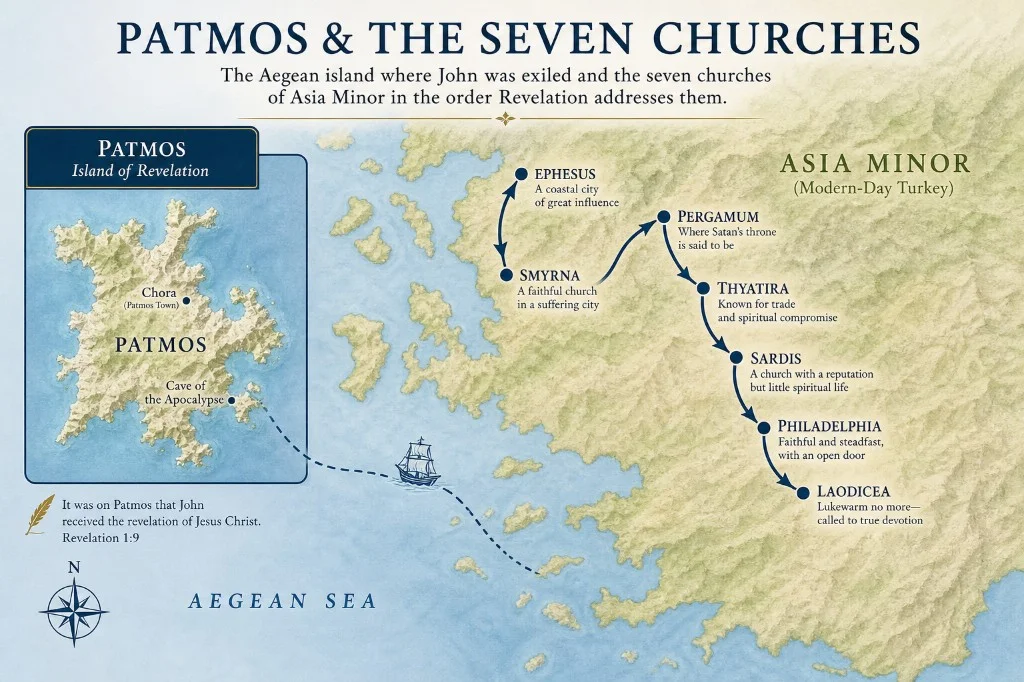
- Prologue (Revelation 1). John introduces himself, dates the vision to his exile on Patmos, and describes his encounter with the risen Christ standing among seven golden lampstands.
- Letters to the seven churches (Revelation 2–3). Seven short letters to real first-century churches in Asia Minor (modern western Turkey): Ephesus, Smyrna, Pergamum, Thyatira, Sardis, Philadelphia, and Laodicea.
- Apocalyptic visions (Revelation 4–22:5). The longest section. John is taken up into heaven and shown a series of visions organized around four sets of sevens (seven seals, seven trumpets, seven signs, seven bowls), ending with the fall of Babylon, the return of Christ, the final judgment, and the arrival of the new Jerusalem.
- Epilogue (Revelation 22:6–21). Final blessings, warnings against adding to or taking from the book, and Christ’s closing promise to return soon.
That outline is the reason the book holds together. The visions are not random. They follow a four-act drama with repeated patterns of seven.
Chapter-by-chapter summary
The summaries below are short by design: one or two sentences per chapter to give you the shape of the book. They use the standard chapter divisions found in modern English Bibles.
Revelation 1: Prologue and vision of Christ. John, exiled to the island of Patmos for his testimony about Jesus, hears a voice “like a trumpet” and turns to see the risen Christ standing among seven golden lampstands. Christ commissions him to write to seven churches in Asia.
Revelation 2: Letters to Ephesus, Smyrna, Pergamum, Thyatira. Four of the seven letters. Ephesus is commended for endurance but rebuked for losing its “first love.” Smyrna is praised for faithfulness under persecution. Pergamum holds fast despite the city’s idolatry. Thyatira is recognized for love and faith but warned about tolerating a false prophetess.
Revelation 3: Letters to Sardis, Philadelphia, Laodicea. Sardis has a reputation for being alive but is “dead” and called to wake up. Philadelphia is faithful and given an “open door.” Laodicea is “lukewarm” and urged to repent, with Christ standing at the door and knocking.
Revelation 4: The throne room of heaven. John is taken up to heaven and sees a throne surrounded by 24 elders and 4 living creatures who never stop worshipping God: “Holy, holy, holy, is the Lord God Almighty.”
Revelation 5: The scroll and the Lamb. A sealed scroll is held by the one on the throne, and only the Lamb (Christ, “looking as if it had been slain”) is worthy to open it. All of heaven erupts in worship.
Revelation 6: The first six seals. As the Lamb opens the first six seals, the four horsemen ride out (conquest, war, famine, death), the martyrs cry out for justice, and a great earthquake shakes the cosmos.
Revelation 7: The 144,000 and the great multitude. Between the sixth and seventh seals, John sees 144,000 sealed from the tribes of Israel and a countless multitude “from every nation, tribe, people, and language” standing before the throne.
Revelation 8: The seventh seal and four trumpets. The Lamb opens the seventh seal. Heaven goes silent for half an hour. Then four angels sound the first four trumpets, and judgment falls on the earth, sea, rivers, and sky.
Revelation 9: The fifth and sixth trumpets. The fifth and sixth trumpets release demonic locusts and an army of 200 million horsemen. Even after the devastation, humanity refuses to repent.
Revelation 10: The mighty angel and the little scroll. A mighty angel comes down with an open scroll. John is told to eat it (sweet in his mouth, bitter in his stomach) and to prophesy again about many peoples and nations.
Revelation 11: The two witnesses and the seventh trumpet. Two prophetic witnesses testify for 1,260 days, are killed by the beast, and rise again after three and a half days. The seventh trumpet sounds, and heaven announces, “The kingdom of the world has become the kingdom of our Lord.”
Revelation 12: The woman, the child, and the dragon. A woman gives birth to a son who will “rule all nations.” The dragon (Satan), defeated by the archangel Michael, is cast down to earth and goes after her offspring.
Revelation 13: The two beasts. A beast rises from the sea (often identified with Rome or the antichrist) and is empowered by the dragon. A second beast from the earth enforces its worship with the mark of the beast: the famous number 666.
Revelation 14: The Lamb on Mount Zion and the harvest. The Lamb stands with the 144,000 singing a new song. Three angels announce the eternal gospel, Babylon’s fall, and a warning about the beast. The chapter ends with the earth being harvested in two great judgments.
Revelation 15: The seven angels with the seven last plagues. A heavenly choir sings the song of Moses and the Lamb as seven angels come out of the temple, ready to pour out the seven final bowls of God’s wrath.
Revelation 16: The seven bowls of wrath. The seven bowls are poured out on the earth (sores, sea-to-blood, scorching sun, darkness, the Euphrates dries up), and the kings of the earth gather at a place called Armageddon.
Revelation 17: The great prostitute and the beast. A woman called “Babylon the Great” sits on a scarlet beast. An angel interprets her as the corrupt world system (wealthy, seductive, opposed to God) that the beast will eventually destroy.
Revelation 18: The fall of Babylon. Heaven announces and laments Babylon’s collapse. Kings, merchants, and seafarers mourn as the great city is destroyed “in a single hour.”
Revelation 19: “Hallelujah” and the rider on the white horse. Heaven erupts in four “Hallelujahs” at Babylon’s fall and announces the marriage supper of the Lamb. Christ then returns on a white horse, named “Faithful and True” and “the Word of God,” and defeats the beast and the false prophet.
Revelation 20: The thousand-year reign and final judgment. Satan is bound for a thousand years and the saints reign with Christ. After a final rebellion, Satan is destroyed, and the dead (“great and small”) are judged at the great white throne.
Revelation 21: The new heaven and new earth. A new heaven and new earth replace the old, and the new Jerusalem comes down from God as “a bride adorned for her husband.” There is no more death, mourning, or pain.
Revelation 22: The river of life and Christ’s return. A river of the water of life flows from the throne of God and the Lamb. Jesus promises, “Behold, I am coming soon,” and the Bible itself closes with the prayer: “Come, Lord Jesus. Amen.”
Major themes in Revelation
Five themes run through all 22 chapters and tie the visions together:
- Worship is the center of history. Every major scene cuts back to a worship scene around the throne (Revelation 4–5, 7, 11, 15, 19). The book is, among other things, a vision of what the universe looks like from heaven’s perspective.
- Jesus is Lord of history. The Lamb who was slain is the only one worthy to open the scroll. Empires rise and fall, but the storyline is being directed by Christ.
- Persecution and perseverance. The seven churches face real first-century pressure: economic, social, and imperial. Christ repeatedly calls them to “overcome” and “endure.”
- Two cities. Revelation contrasts Babylon (the world system of pride, wealth, and violence) with the new Jerusalem (the city of God, healed and unified). The book asks every reader which city they are living for.
- New creation hope. The book does not end with destruction. It ends with renewal: a new heaven, a new earth, and the river of life. Revelation is, in the end, a hopeful book.
Those five threads are why most Christian traditions have read Revelation as encouragement to endure under pressure, rather than as a code to crack.
Who wrote Revelation, and when?
Revelation identifies its author simply as “John,” writing from the island of Patmos (Revelation 1:9). From the 2nd century on, Christian writers (Justin Martyr, Irenaeus, Origen) identified this John with John the Apostle, who also wrote the Gospel of John and the three Johannine letters.2
Modern scholars are more divided. Some accept the traditional identification. Others argue the author was a different first-century prophet, sometimes called John of Patmos or John the Elder, partly because the Greek style of Revelation differs from the Gospel of John.3 In either case, the early church received the book as the work of a real, authoritative figure named John.
On dating: the most widely held view is around 95 AD, during the reign of the Roman emperor Domitian (81–96 AD). This is the date given by Irenaeus in the late 2nd century.2 A minority of scholars favor an earlier date in the late 60s AD under Nero. The 95 AD date is still the standard in most reference works.3
Why is Revelation the last book of the Bible?
Revelation sits at the end of the Bible for two reasons: what it is about, and how the early church received it.
Its subject is the end of the story: Christ’s return, the final judgment, and the new creation. The Bible’s storyline runs from creation (Genesis 1) to new creation (Revelation 21–22), and Revelation supplies the ending.
That placement was not immediate. In the 4th century, the church historian Eusebius listed Revelation among the “disputed” books in the East. It was widely accepted in the West, included in Athanasius’s 367 AD Festal Letter (the first list to name exactly the 27 New Testament books we use today), and ratified at the regional councils of Hippo (393) and Carthage (397).4 Every Christian canon since then puts Revelation at the end.
Frequently asked questions
How many chapters are in Revelation?
The Book of Revelation has 22 chapters and 404 verses. The chapter count is the same in every major Christian tradition (Protestant, Catholic, Eastern Orthodox, Ethiopian).
Is Revelation 22 the last chapter of the Bible?
Yes. Revelation 22 is the final chapter of the Book of Revelation and the final chapter of the entire Bible. It ends with Christ’s promise, “Behold, I am coming soon,” and the prayer, “Come, Lord Jesus.”
How long is the Book of Revelation?
Revelation is roughly 12,000 words in English (about 35 to 40 pages in a standard hardcover Bible). Read aloud, it takes about 75 to 90 minutes, which means you can read the whole book in one sitting.
Who wrote the Book of Revelation?
The book identifies its author as John, writing from the island of Patmos. Christian tradition identifies him with John the Apostle; modern scholars sometimes distinguish him as a separate figure called John of Patmos. Most scholars date the book to around 95 AD, during the reign of the Roman emperor Domitian.
What are the four parts of Revelation?
Revelation is usually divided into four sections: prologue (chapter 1), letters to the seven churches (chapters 2–3), apocalyptic visions (chapters 4–22:5), and epilogue (chapter 22:6–21).
Why do some Christians avoid reading Revelation?
Three things tend to come up. The symbolism is dense and can feel intimidating. The violence in the trumpets and bowls can be unsettling. And bad end-times predictions over the years have soured some readers on the book. Most Christian traditions read Revelation as a vision of Christ's victory and the church's endurance, rather than a code to crack.
What is the shortest chapter in Revelation?
Revelation 15, with only 8 verses. It is a short transitional interlude before the bowl judgments of chapter 16.
What is the longest chapter in Revelation?
Revelation 2, with 29 verses, contains the first four of the seven letters to the churches. Revelation 21 (27 verses) and Revelation 18 (24 verses) are the next longest.
References
- Richard Bauckham, The Theology of the Book of Revelation (Cambridge: Cambridge University Press, 1993), 1–22. Bauckham’s four-section outline (prologue, letters, visions, epilogue) is the structural framework adopted in most modern critical commentaries on Revelation. See also G. K. Beale, The Book of Revelation: A Commentary on the Greek Text, NIGTC (Grand Rapids: Eerdmans, 1999), 108–151. ↩
- Irenaeus of Lyons, Against Heresies 5.30.3 (c. 180 AD), is the earliest surviving source to identify the author as John the Apostle and to place the vision “toward the end of Domitian’s reign.” Translated text in Ante-Nicene Fathers, vol. 1, ed. Alexander Roberts and James Donaldson (Buffalo: Christian Literature Publishing, 1885). ↩
- For a representative survey of the modern authorship and dating debate, see Craig R. Koester, Revelation: A New Translation with Introduction and Commentary, Anchor Yale Bible 38A (New Haven: Yale University Press, 2014), 65–79. Koester reviews the cases for both the 95 AD (Domitianic) and late-60s (Neronian) dates and concludes the 95 AD date is the better supported. ↩
- Bruce M. Metzger, The Canon of the New Testament: Its Origin, Development, and Significance (Oxford: Clarendon Press, 1987), 209–212 (on Athanasius’s Festal Letter of 367 AD) and 237–238 (on the councils of Hippo 393 and Carthage 397). ↩